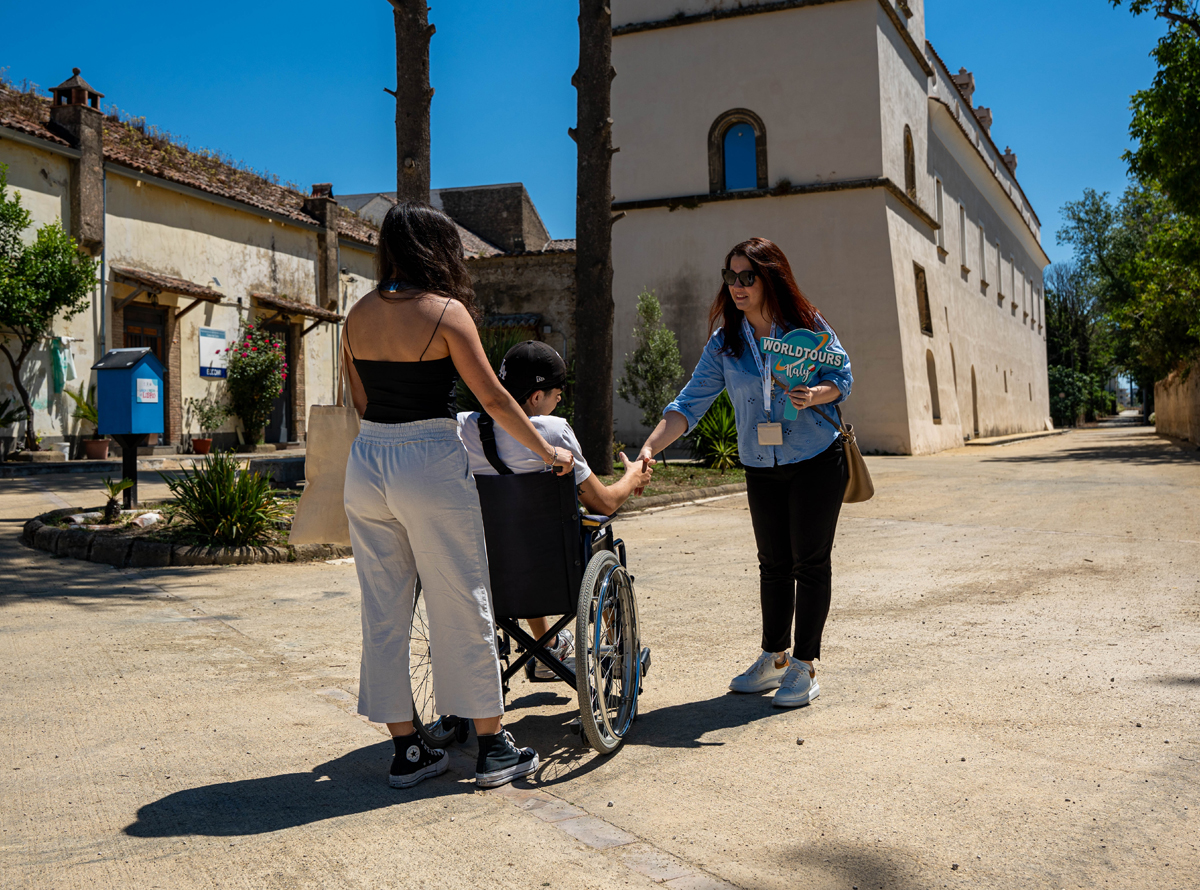
Imagine crossing authentic rural landscapes, among ancient farmhouses, rows of vines, and majestic Bourbon sites, without any barrier.
For those who experience disability as part of everyday life, organizing a cultural visit often turns into a challenge made up of concrete obstacles and incomplete information.
And yet, in the countryside of Caserta, two gems such as the Casale di Teverolaccio and the Royal Site of Carditello are rewriting the very concept of accessible tourism in Campania.
An itinerary that weaves together sustainability, hospitality, food and wine, and history, designed to truly include anyone who wants to explore the cultural roots and flavors of this land. Get ready to discover how to fully enjoy a limitless experience among workshops, tastings, art, nature, and memory, with practical tools, real testimonies, and all the useful information for an accessible tour between Teverolaccio and Carditello.
Turn your day into an experience of Bourbon history and local flavors: book the “Carditello and Teverolaccio Tour.”
Casale di Teverolaccio, Legambiente’s rural hub in Succivo
The Casale di Teverolaccio is not only a 15th-century fortified farmhouse in the heart of the Aversa countryside, but also a true laboratory of social and environmental innovation. From an asset confiscated from organized crime, it has been reborn as a rural hub managed by Legambiente, a point of reference for those who believe in the strength of accessible common goods in Campania.
Today, the enhancement of the Casale is intertwined with a cultural project that places accessibility at its center: here, every initiative — from festivals to urban gardens, from contemporary art exhibitions to Slow Food markets — responds to increasingly strict requirements in terms of removing architectural and cognitive barriers. After works also supported thanks to PNRR funds and regional calls for 2024–2025, the site has reached new standards of inclusiveness.
Strengths for accessibility at Teverolaccio:
Step-free entrance, equipped with a compliant ramp and automatic door.
Paved and wide internal routes, easily usable with wheelchairs and walkers.
Accessible restrooms with grab bars, emergency bell, and lowered mirrors.
Visual and tactile signage for orientation, also for partially sighted people.
Operators trained in inclusive hospitality and the presence of LIS guides available upon booking.
Accessible educational workshops, such as horticultural therapy, ceramics, and Slow Food cooking.
Shaded spaces and rest areas for those who have difficulty walking.
In 2026, the accessible Teverolaccio–Carditello itinerary often begins precisely at the Casale, thanks to collaboration with trade associations (ANGLAT, Unione Italiana Ciechi, ENS) and the implementation of an interactive map of obstacle-free routes, which can be consulted directly via QR code at the entrance and online.
The value of the common good and social transformation
The Casale di Teverolaccio embodies the rebirth of the territory, becoming a symbol of social inclusion and regeneration. This place, returned to citizens and schools, now hosts:
Food and wine markets and festivals with accessible stands and guided tastings for people with sensory disabilities.
Environmental education workshops aimed at students, older people, families, and mixed groups.
Shows and concerts with platforms and reserved areas for people with reduced mobility.
Accessible Carditello events organized in synergy with the Carditello Foundation, creating bridges between the two sites.
Thanks to its inclusive proposals and the availability of qualified staff, the accessible visits to the Casale di Teverolaccio have become a case study for universities and social science students interested in the accessibility of common goods.
Alberata Aversana Vineyard, Slow Food presidium and tasting of native wines
Along the route between Teverolaccio and Carditello, the landscape changes: cultivated fields, rows of vines married to poplars, ancient training systems that tell a centuries-old story. Here lies the Alberata Aversana Vineyard, today a Slow Food Presidium, at the heart of an accessible food-and-wine experience that engages all the senses.
The accessible tastings organized by local realities include:
Obstacle-free routes among the vines, with wooden walkways and shaded areas for frequent stops.
LIS explanations and audio guides for people with hearing and visual disabilities.
Informational materials in Braille and in high-readability formats.
Guided tastings of native wines such as Asprinio, with ergonomic glasses and supports for those with motor difficulties.
Cooking and horticultural therapy workshops adapted for guests with specific needs.
The Alberata Aversana Vineyard offers a unique setting for those seeking accessible travel in Caserta, thanks to collaborations with producers, chefs, and associations committed to personalizing the experience. Beyond the pleasure of wine, the story is enriched with rural traditions and stories of redemption, because here every visit is an opportunity for authentic encounter and exchange.
Slow Food and accessible tourism: a winning combination
Since 2024, Slow Food Campania has included the vineyard among its accessible food-and-wine itineraries to promote inclusion and the culture of good, clean, and fair food. During the busiest seasons — spring, late summer, and autumn — accessible Teverolaccio tours often include stops dedicated to:
Multisensory workshops for blind and partially sighted people, such as tactile exploration of the vines and olfactory tasting.
Personalized gastronomic experiences, with menus for specific needs, intolerances, and dysphagia.
Inclusive educational activities for school groups with special needs, in collaboration with specialized educators.
Presentations and meetings with producers, to share stories and values linked to the territory.
Royal Site of Carditello, the Royal Delight of the Bourbons recently restored
After the Casale and the vineyards, the journey leads to the Royal Site of Carditello: one of the most fascinating Bourbon residences in Southern Italy, immersed in a park of over 50 hectares among meadows, woods, and ancient royal livestock areas. Managed since 2016 by the Carditello Foundation, the site has become a symbol of enhancing common goods and cultural innovation, with a strong commitment to accessibility in all its forms.
Accessible services at Carditello are among the most advanced in the region:
Barrier-free entrances and routes, with a lift to reach the upper floors and ramps with compliant slope.
Tactile map and audio guides in Italian, English, and LIS for those with sensory disabilities.
Equipped bathrooms and changing rooms in several parts of the complex.
Reserved parking very close to the main entrance, with oversized spaces and highly visible horizontal and vertical signage.
Guides and staff trained in hospitality and assistance techniques.
Relaxation areas and accessible picnic areas for families and mixed groups.
Accessible Carditello events with reserved seating, assistance services, and materials for facilitated communication.
A model of inclusion and enhancement
The accessible Royal Site of Carditello is now at the center of projects co-financed by the Ministry of Culture and the Campania Region: ad hoc music festivals, multilingual theatrical visits, and riding camps for children and young people with disabilities. Thanks to the network of local operators and collaboration with ENS and associations of deaf people, in recent years the site has adopted an integrated accessibility protocol, updated in 2025 in line with the new EU Directive 2019/882.
Comparison table of accessible services between Teverolaccio and Carditello
The history and cultural value of the two sites
To fully understand the meaning of an accessible Teverolaccio and Carditello tour, it is not enough to focus on logistics: it is necessary to rediscover the strong historical roots of these places. The Casale di Teverolaccio, built on medieval reclaimed land, became in the 15th century a center of agricultural production and a stronghold of legality, while Carditello was desired by Ferdinand IV of Bourbon as a model “Royal Farm,” a laboratory of rural experimentation, culture, and art.
Today these spaces testify to how the enhancement of common goods passes through the removal of barriers, both material and cultural, and through planning that places the person and the community at the center.
The role of common goods and the enhancement of the territory
Inclusiveness around Teverolaccio and Carditello is not limited to the two sites, but is reflected throughout the territory: shared gardens, social agriculture workshops, slow tourism circuits, partnerships with schools and universities. These projects have restored environmental and social dignity to an area marked by decades of abandonment, crime, and depopulation, transforming it into one of the most innovative accessible itineraries in Campania.
Accessibility: definition and regulatory framework
When speaking about accessibility at Teverolaccio and Carditello, the term goes far beyond simply removing architectural barriers. It means guaranteeing everyone — people with motor, sensory, or cognitive disabilities, older people, families with small children — the possibility of fully experiencing the cultural journey, thanks to personalized solutions and high-quality services.
The key laws on accessibility in cultural heritage
Respect for the rights of people with disabilities is at the center of policies concerning cultural heritage. Among the main regulatory references updated to 2026:
Law 104/92: protection of social inclusion and the right to culture.
Law 13/89 and Ministerial Decree 236/89: obligation to remove architectural barriers and technical accessibility requirements.
EU Directive 2019/882: minimum criteria for accessibility of services and websites/e-government.
Regional and municipal accessibility plans, updated in 2024–2025 in line with PNRR policies for the enhancement of common goods.
Italian and European regulations have required all public cultural space managers, starting from 2025, to publish annual reports on the state of accessibility and the presence of self-assessment forms for visitors.
Projects and initiatives for accessibility at Teverolaccio and Carditello
In recent years, several inclusive projects have contributed to innovating the tourist and cultural offering of the two sites:
Sensory routes created thanks to regional and PNRR funds.
Co-design workshops with disabled users, to improve services and communication.
Implementation of assistive technologies such as visiting apps, QR codes, vocal guides, and LIS.
Annual selection of accessible events in collaboration with trade associations and universities.
Insight box: Carditello Accessibility Plan
In 2025, the Carditello Foundation approved a new three-year accessibility plan, which provides for: facilitated signage, expansion of accessible relaxation areas, reserved shuttle services, continuous staff training, and monitoring through digital systems of feedback from disabled users.
Practical tips and useful resources
To guarantee the best possible experience, here are practical tips and verified resources for those who wish to organize an accessible tour between Teverolaccio and Carditello in 2026.
Checklist for planning the accessible tour
Check the status of accessible services on the chosen dates via the official website or toll-free number.
Book transport and shuttle at least 48 hours in advance.
Request LIS guides, audio guides, companions, or Braille materials in advance.
Prepare documentation for concessions and priority access.
Check the schedule of accessible events and choose tailor-made activities.
Download the interactive map to plan internal routes, via link and QR code.
Report any dietary needs or health requirements for workshops and tastings.
Bring with you what is needed for personal comfort, such as a water bottle, hat, and any aids.
Contact assistance in case of unforeseen events during the visit.
Full accessibility: electric van, PRM routes, specialized guides
The experience is designed to guarantee continuity and comfort in every phase of the route, from departure to return to Naples. Transfer takes place by electric van, a solution that allows smooth movement between the different stages of the tour, departing at 8:00 a.m. from the hotel or a central meeting point.
The routes are designed for people with reduced mobility and companions, with attention to spaces and visiting times:
Facilitated access at the visited sites, including the Casale di Teverolaccio and the Royal Site of Carditello.
Leisurely organized itineraries, with planned stops between one stage and the next.
Guided visits to the Royal Apartments, the Royal Park, and the English Garden of the Royal Palace, with defined duration and manageable breaks.
Presence of specialized guides, also available upon request for specific needs.
The Casale di Teverolaccio, today Legambiente’s Rural Hub in the municipality of Succivo, also integrates social and inclusive activities into the route, such as gardens managed by older people and the Terrah Teverolaccio Rural Hub project active since June 2024 with internships dedicated to people with disabilities.
Ecotourism and sustainability: why choose zero-emission tours
This itinerary is part of a proposal for responsible tourism that enhances the territory while reducing environmental impact. The use of an electric van for travel between Naples, Teverolaccio, and Carditello contributes to a low-emission experience.
The stages of the tour strengthen this vision:
The Casale di Teverolaccio promotes social agriculture and sustainable practices, with shared gardens and vineyards cultivated according to historic traditions such as the Alberata Aversana.
Tastings are based on zero-kilometer products, with attention to seasonality and the local supply chain.
Lunch at the agriturismo highlights typical ingredients of the territory, including Mozzarella di Bufala Campana DOP.
The Royal Site of Carditello represents a historic model of agricultural management and livestock breeding, still visible in the Persano Government Breed horses present in the 18th-century gallop track.
The combination of sustainable mobility, local production, and enhancement of common goods makes the tour consistent with the principles of contemporary ecotourism.
How to book on wordtoursexperience.eu
The tour is booked directly online through the World Tours Experience website, with a simple and structured procedure for defining every detail of the experience.
The following are provided:
Selection of the date and the accessible tour dedicated to Teverolaccio and Carditello.
Possibility to indicate specific needs, including requests related to accessibility and support during the visit.
Entry of participant data and online booking confirmation.
During the booking phase, it is useful to check:
Program times, with departure at 8:00 a.m. and return scheduled at 5:50 p.m.
Sequence of the stages, from the Royal Palace to the Casale di Teverolaccio and then to the Royal Site of Carditello.
Presence of guided visits, tastings, and lunch at an agriturismo included in the tour.
The availability of services and activities is confirmed during the request phase, in order to build an experience consistent with the needs of the group.
Explore the Royal Site of Carditello and the Casale di Teverolaccio in one organized itinerary: book the “Carditello and Teverolaccio Tour.”
Toward an increasingly accessible Campania
The accessible tour between Teverolaccio and Carditello is not only a model of tourist hospitality, but a tangible example of how culture, agriculture, and collective memory can become tools of inclusion and social rebirth. The commitment of institutions, associations, and citizens has given life to a network of accessible common goods that is becoming a model throughout Italy.
The prospects for the future are encouraging: the 2024–2026 Regional Accessibility Plan provides for new interventions on tactile routes, smart signage, expansion of relaxation areas, and greater digital integration. Partnerships between the Carditello Foundation, Legambiente, Slow Food, and local entities continue to generate new opportunities for events, workshops, campuses, and festivals under the banner of participation and sharing.
If you want to contribute, report specific needs, or give voice to your experience, contact the sites or the reference associations directly: every piece of feedback is valuable in making this extraordinary itinerary increasingly welcoming and innovative. Whether you are a traveler, an educator, an operator, or simply curious, Teverolaccio and Carditello are waiting to let you experience Campania as you have never seen it before: without limits, without barriers, together.
FAQ - Frequently asked questions about the accessible Teverolaccio and Carditello tour
What does an accessible tour between Teverolaccio and Carditello mean?
A cultural, natural, and food-and-wine itinerary designed to be enjoyed without barriers by people with all types of disabilities, older people, families, and mixed groups.
What services are available at the two sites for people with disabilities?
Barrier-free entrances, accessible internal routes, equipped bathrooms, LIS guides, audio guides, tactile maps, inclusive events and workshops, reserved parking, and trained staff.
How can I book an accessible visit?
Through the official portals, by choosing the date and specifying your needs. You can request additional services such as transport, companion, or LIS guide.
Are the routes also suitable for blind people or people with sensory disabilities?
Yes, thanks to tactile maps, audio guides, multisensory routes, and trained staff.
Are accessible events organized during the year?
Yes, especially in spring, summer, and autumn, with scheduled festivals, concerts, workshops, and tastings.
Are specialized guides or companions available?
Yes, upon request at the time of booking.
Where can I find updated information on accessibility?
On the official websites of the two sites and on the regional Turismo Accessibile Campania portal.
Are assistance animals allowed?
Yes, both at Teverolaccio and at Carditello, provided they are identified.
What are the main architectural barriers still present?
Some sections of the outdoor route among the vineyards, in case of bad weather, require mobile walkways, provided on request. Internally, everything is accessible.
Are discounts or concessions provided for people with disabilities?
Yes, free or reduced admission depending on the event, with concessions also for companions.
What is the best time to visit from an accessibility perspective?
Spring and autumn for outdoor activities and festivals, summer for evening events, and winter for specific initiatives such as Christmas workshops.