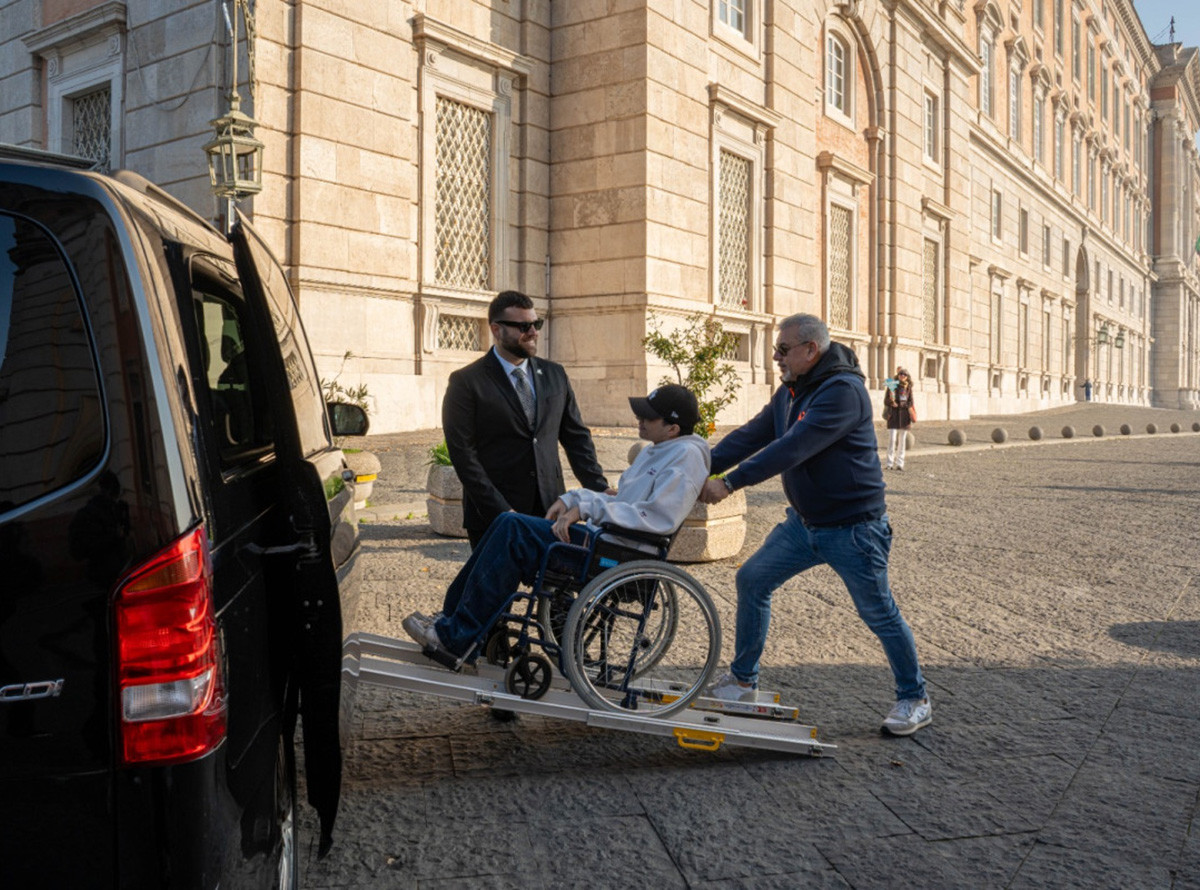
Imagine walking along monumental avenues, hearing the echo of Bourbon history, and admiring unique landscapes without ever having to worry about obstacles.
Campania preserves an extraordinary heritage that, today more than ever, has become accessible to every visitor: the Royal Palace of Caserta and the Bourbon Treasures, including the Belvedere of San Leucio, the medieval village of Casertavecchia, and the engineering spectacle of the Carolino Aqueduct, can be discovered through inclusive routes and tailored services for every need.
Experience the Royal Palace of Caserta, San Leucio, and the Bourbon treasures through an accessible and barrier-free experience: book the private tour “Royal Grandeur and Accessible Heritage” now.
Why choose an accessible tour: benefits for all visitors
Far from the most crowded routes, this itinerary offers a concrete alternative to traditional tourist circuits, highlighting a historical and cultural heritage recognized by UNESCO and less affected by intensive visitor flows. Here the journey unfolds in more accessible environments, with spacious settings, relaxed timing, and an organization designed to avoid issues related to crowds.
Choosing the Bourbon sites of Caserta means accessing a more balanced experience, where attention to accessibility is combined with the quality of the visit. Each stop is structured to be inclusive and well connected, offering a model of sustainable and fully usable tourism, in which discovery takes place without barriers and with greater peace of mind.
The Royal Palace of Caserta, the Royal Apartments, the Park, and the English Garden
The visit to the Royal Palace of Caserta represents the starting point of an itinerary that combines historical value, architectural quality, and accessibility. Designed by Luigi Vanvitelli, the Bourbon residence was conceived as a monumental complex intended to integrate indoor and outdoor spaces into a harmonious and functional system. The organization of the rooms and routes allows for progressive use, without interruptions, making the visit suitable for different mobility needs.
The Royal Apartments: an accessible museum route
Inside the palace, the Royal Apartments unfold in a sequence of rooms that preserve decorations, original furnishings, and iconographic programs connected to the Bourbon court. The route is structured to guarantee continuity and clear orientation, thanks to integrated solutions:
Elevators connecting the main levels.
Ramps that make it easier to overcome differences in height.
Visual signage and clearly defined guided routes.
Availability of audio guides and accessible informational materials.
Among the most representative spaces are the reception rooms, the private apartments, and the ceremonial areas, which make it possible to understand the organization of court life through a coherent succession of spaces.
The Royal Park: monumental axis and facilitated routes
Outside, the Royal Park stretches along a perspective axis that connects the palace to the upper part of the complex. The main route is wide and linear, with an even surface that makes it easier to traverse even with mobility aids. Along the way there are fountains, basins, and architectural scenography that mark the visit gradually.
Services designed to improve the experience are available:
Rest areas distributed along the route.
Shaded areas for breaks during the visit.
Rental of mobility aids upon request.
Accessible restrooms in several points of the park.
The English Garden: landscape and botanical variety
The English Garden introduces a more natural layout compared with the formal park, with winding paths, varied vegetation, and landscaped settings designed to evoke different scenarios. Accessible routes have also been developed in this area, with attention to safety and the readability of the itineraries.
The entire complex is configured as a continuously visitable space, where every element is integrated into a system that allows movement without barriers, while maintaining a high quality of cultural and landscape experience.
The San Leucio Complex, the Bourbon workers’ town, and the Silk Museum
The San Leucio Complex represents a unique example of social and productive organization linked to silk manufacturing, developed during Bourbon rule as a project for an ideal community. Created by the will of Ferdinand IV of Bourbon, the site integrates residential, productive, and cultural functions into a coherent system, now recognized for its historical value and included in the UNESCO heritage together with the Royal Palace and the Carolino Aqueduct.
The silk town: organization and social model
San Leucio is not only a museum complex, but a true experiment in an industrial town advanced for its time, based on precise rules and on a structured organization of labor. Silk production formed the core of the entire system, with looms and silk mills operating according to high standards and with centralized management.
The visit route makes it possible to understand this model through several elements:
Original production spaces linked to silk processing.
Living quarters intended for the workers.
Documents and tools illustrating how the community functioned.
Multimedia supports that facilitate the historical reading of the site.
This structure makes it possible to interpret San Leucio as an integrated project, where work, daily life, and social organization were closely interconnected.
The Silk Museum: machinery and manufacturing tradition
Within the complex lies the Silk Museum, which preserves historic looms, machines, and textile samples used in production. The exhibition route is organized by phases, from thread processing to the finished product, offering a complete view of the manufacturing process.
Among the main elements of the visit:
Original looms, still functioning in some demonstration cases.
Collections of historic fabrics and sample books.
Audiovisual installations illustrating production techniques.
Explanatory panels accessible also to visitors with specific needs.
The museum layout encourages gradual understanding, with spaces distributed in a linear and easily traversable way.
Accessibility and inclusive routes
In recent years, the San Leucio Complex has undergone targeted interventions to improve accessibility and guarantee a barrier-free visit. The organization of the spaces allows for a smooth experience, with integrated solutions:
Accessible entrances with reserved parking nearby.
Elevators and stair lifts connecting the various levels.
Facilitated internal routes for people with reduced mobility.
Availability of inclusive audio guides and multimedia contents.
The configuration of the site makes it possible to visit both the museum areas and the outdoor spaces continuously, maintaining a constant level of accessibility and readability of the route.
Casertavecchia, the most beautiful medieval village in Campania (with a typical lunch)
The village of Casertavecchia stands on the hills a few kilometers from the Caserta plain and preserves an urban layout of medieval origin that has remained almost intact. Stone streets, historic buildings, and panoramic views define a setting that clearly reveals the evolution of the territory over time. The visit is included as a stop dedicated to the most authentic dimension of the journey, where architecture, landscape, and gastronomic tradition intertwine naturally.
The medieval village: urban structure and points of interest
Casertavecchia is organized around a system of alleys and squares converging toward the main nucleus, dominated by the Cathedral of Casertavecchia, a significant example of Romanesque architecture. The arrangement of the spaces follows a historical logic, with routes adapting to the morphology of the land and offering continuous changes of perspective.
During the visit it is possible to observe:
Historic stone buildings with original architectural elements.
Squares and small open spaces serving as stopping and observation points.
Religious and civil structures from the medieval period.
Panoramic views over the plain and the surrounding territory.
This configuration makes the village a compact environment, easy to explore on foot, with a strong identity.
The typical lunch: local cuisine and short supply chain
The stop in Casertavecchia includes a moment dedicated to local gastronomy, with lunch in a trattoria in the village offering traditional Campanian dishes. The culinary offer is based on ingredients from the territory and on preparations linked to rural and seasonal culture.
Among the characteristics of the experience:
Use of local zero-kilometer products.
Menus that enhance traditional Campanian recipes.
Informal settings placed within the historic context of the village.
Possibility of adapting the service for specific needs.
Lunch is integrated into the visit, offering a functional pause consistent with the cultural itinerary.
Accessibility and characteristics of the route
Casertavecchia presents a partial level of accessibility, linked to the historic nature of the village and the presence of ancient paving and slopes. Solutions can nonetheless be identified that make the visit easier, thanks to selected routes and services available in some areas.
Useful elements for the visit:
Main streets with easier access compared with the secondary alleys.
Presence of some trattorias equipped with accessible services.
Parking areas in the zones surrounding the historic center.
Local indications on the most practicable routes.
This stop is included as a moment of controlled exploration, where it is possible to experience the atmosphere of the village while maintaining an adequate level of usability, in continuity with the other experiences of the tour.
Ponti della Valle, the Carolino Aqueduct, a UNESCO engineering masterpiece
The Ponti della Valle represent one of the most spectacular points of the entire itinerary and constitute the most iconic section of the Carolino Aqueduct, once again designed by Luigi Vanvitelli. This imposing 18th-century hydraulic infrastructure was built to supply the Royal Palace of Caserta and the production system of San Leucio, combining technical functionality with architectural monumentality.
A monumental work between engineering and landscape
The Ponti della Valle develop over three orders of stone arches, reaching such a height and length that they dominate the surrounding landscape. The structure fits harmoniously among the hills, creating a visual effect that combines monumental scale and environmental integration.
During the visit it is possible to observe:
The three superimposed rows of arches, perfectly proportioned.
The insertion of the work into the natural hilly context.
The original construction materials and the engineering techniques adopted.
The continuity of the hydraulic system that connected several Bourbon sites.
The aqueduct is not only a functional infrastructure, but a central element in the territorial planning of the time.
The panoramic viewpoint: visual and photographic experience
The Ponti della Valle area is now organized to offer simple and immediate use, with a panoramic viewpoint that makes it possible to appreciate the entire structure safely. The open view allows visitors to grasp the scale of the work and its relationship with the territory.
Characteristics of the visitor area:
Wide spaces that make stopping and observing easier.
Areas dedicated to photography with an unobstructed view of the aqueduct.
Presence of clear and accessible informational signage.
Direct connections with parking areas in the immediate vicinity.
This stop is configured as the concluding moment of the tour, with a strong visual impact.
Accessibility and available services
In recent years, the area has been the subject of interventions to improve accessibility and guarantee an inclusive visit. The paths have been adapted to allow easier access also for people with reduced mobility.
Available services and solutions:
Pedestrian routes with stable, non-slip paving.
Reserved parking spaces near the panoramic point.
Equipped areas with accessible tables for resting.
Dedicated and signposted restroom facilities.
The organization of the spaces allows for a short but complete visit, easily integrated into the day’s program and consistent with the level of accessibility guaranteed throughout the entire itinerary.
Tour by electric van, PRM accessibility, and guaranteed sustainability
The entire itinerary is designed to guarantee continuity in transfers among the different sites, thanks to the use of dedicated vehicles directly connecting the Royal Palace of Caserta, the San Leucio Complex, the village of Casertavecchia, and the Ponti della Valle. The transport service is a central component of the experience, designed to eliminate logistical issues and guarantee a regular flow throughout the day.
Electric vehicles: sustainable and quiet mobility
The tour takes place aboard electric vans, chosen to reduce environmental impact and improve the quality of the journey. The absence of direct emissions and the reduction of noise contribute to a more sustainable experience, in line with the enhancement of the cultural and landscape sites visited.
Main features of the vehicles:
Electric power with reduction of local emissions.
Smooth and quiet driving, suitable also for historical and natural contexts.
Facilitated access through assisted boarding systems.
Interior spaces organized for orderly passenger management.
This solution makes it possible to maintain coherence between transport methods and goals of protecting the territory.
PRM accessibility: integrated mobility solutions
The vans are configured to accommodate people with reduced mobility, with devices designed to facilitate boarding, remaining on board, and safe disembarkation. The organization of the interior spaces is designed to guarantee stability and comfort during transfers from one stop to another.
Available equipment and services:
Wheelchair lifts integrated into the vehicle.
Anchorage systems to guarantee safety during travel.
Ergonomic seats for companions and other passengers.
Spaces adequate for internal movement.
The entire transport system is designed to minimize complex operations, encouraging autonomy and ease of use.
Continuity of service and tour organization
The connection among the different stops takes place without interruptions, with transfer times optimized to avoid waiting and overlaps. The service is coordinated so as to integrate with visiting hours and participants’ needs.
Organizational elements of the service:
Planned routes among the main sites of the tour.
Stops near accessible entrances.
Coordination with any assistance services upon request.
Possibility of booking in advance to guarantee availability.
This structure makes it possible to enjoy the experience in a linear way, maintaining a constant level of accessibility and sustainability throughout the route.
Useful information and resources for visitors with specific needs
Here is a summary table of the main sites and their level of accessibility:
For updates and assistance:
Royal Palace of Caserta - Official website
Belvedere of San Leucio
Emergency number: 112
Royal Palace accessibility info number: +39 0823 1491201
How to book (World Tours Experience)
To take part in the tour, it is possible to book exclusively through World Tours Experience.
Online booking allows visitors to select a private experience, with services organized to guarantee continuity among the different stops and a constant level of accessibility. The tour includes dedicated transport, assistance upon request, and coordinated management of entry to the main sites.
Booking in advance makes it possible to guarantee service availability and optimal management of the experience throughout the entire route.
FAQ - Frequently asked questions about the accessible tour among the Bourbon Treasures
Is the Royal Palace of Caserta accessible to people with disabilities?
Yes, thanks to ramps, elevators, and dedicated services. Updated information is available on the official website.
What accessible services are available at San Leucio?
Elevators, inclusive audio guides, trained staff, and facilitated routes.
How can I reach the Carolino Aqueduct with accessible transport?
There are shuttle services and reserved parking areas in the panoramic zones of the Ponti della Valle.
Are there recommended routes for visitors with mobility difficulties?
Yes, at each site the facilitated routes are signposted, and tactile maps and clear directions are available.
Is it possible to visit all three sites in a single day?
Yes, by choosing the recommended itinerary and booking accessible transfers.
Where can I find updated information on the accessibility of the Bourbon sites?
On the institutional websites and at the main information points.
Are accessible guided tours in LIS or with audio guide available?
Yes, by reservation at all the main sites.
Which are the nearest and best-equipped parking areas for disabled visitors?
Each site has reserved areas clearly marked on the official map.
Can mobility aids or accompaniment services be booked?
Yes, it is recommended to book them at least 24–48 hours in advance.
What are the main barriers still present along the routes?
Some sections of the village of Casertavecchia have ancient paving and steep slopes; the more accessible streets are nonetheless indicated.
Discover Bourbon Campania without barriers: enjoy an authentic and inclusive experience
With the San Leucio and Carolino Aqueduct Tour, the accessible Royal Palace of Caserta, and an authentic stop in the village of Casertavecchia, every journey becomes an emotional and obstacle-free route.
Book an accessible guided visit or request personalized assistance: let yourself be amazed by the Bourbon Treasures of Campania, where beauty becomes inclusive for everyone.